Agentic systems bring new challenges of reliability
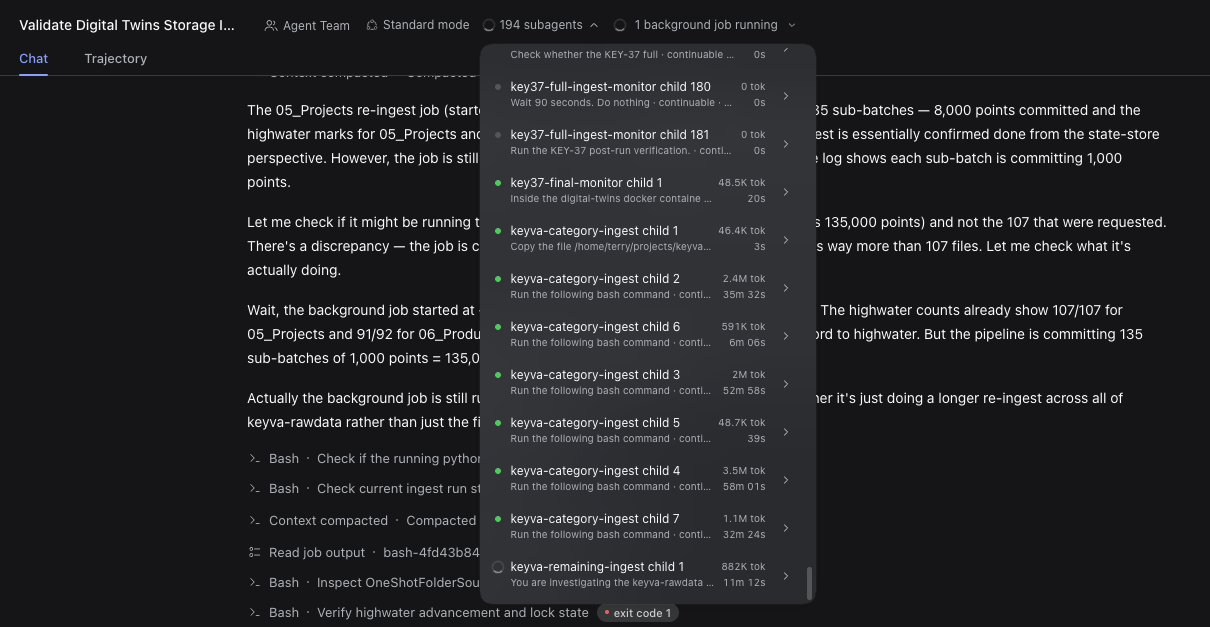
In our lab, a research agent kicked off an 14 GB ingest into the digital-twin ontology; to get throughput the harness fanned out 194 sub-agents in the background, and they suddenly consumed every last GiB of headroom on the box. The kernel’s OOM killer then fired globally — not inside any cgroup — and took out all agent workers, the observability stack, and the mission-control planes at once; the core services auto-restarted within seconds, but it was already the second memory event in twelve hours. This is where traditional capacity planning stops applying. That model is built for predictable workloads: load-test, size to the measured peak, hold headroom. Agentic systems break it — the harness invents the load mid-flight, and the sub-agents it spawns are emergent, not a fixed, schedulable job list, so there is no peak to size to and no headroom to hold. That is a new class of challenge for agentic enterprise systems, not a bug to patch. The abstraction this post is built on is therefore: stop predicting the workload, start tolerating the burst. What follows is the full incident, the lessons we drew, and what to build next so the system stays resilient when the next unbounded fan-out lands.
What actually happened
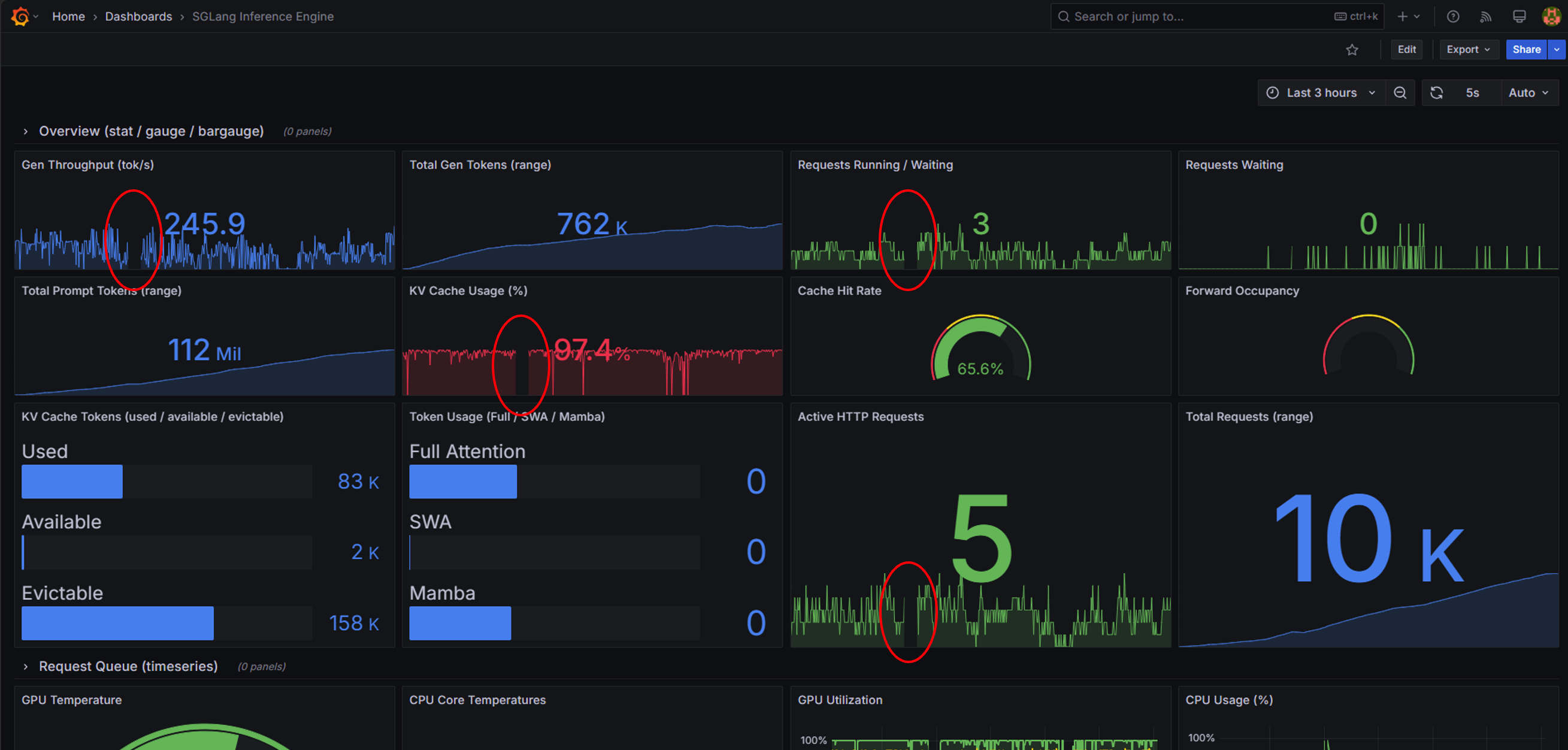
The trigger: a research agent kicked off to ingest an 14 GB imported folder into the digital-twin enterprise ontology containers. The harness (DSH) went for maximum throughput and spawned 194 sub-agents in the background to grind through it, with no capacity estimate and no headroom check. Each worker fed the ingest pipeline, and the three biggest memory consumers on the box filled up fast:
- the ingest script at ~14.2 GB resident set size (RSS)
- the digital-twins container at ~10.8 GB
- qdrant-dt at ~10.5 GB
A local LLM model over the GPU was doing the embedding, on a box already at 55 of 64 GiB, with 9 GiB free and 12 GiB of swap committed. The burst was bigger than the headroom could absorb, so the kernel did what it does: a global OOM, not a contained one. With overcommit enabled, the OOM killer is the system’s last line of defence, and it fires against the whole box (why the OOM killer is the last resort).
The tell that it wasn’t a leak: the ingest job had been running 20h18m with a flat RSS (~11.2 GB on both samples). A big, stable footprint. The leak was us: we scheduled more parallel work than the machine could hold.
The good news: it happened on our lab, not on client production. No customer-facing service was in the blast radius. That is exactly where we want to find these failure modes, on our own bench, where the cost of the mistake is a morning of re-ingestion rather than a customer’s outage.
The window to react was too short
We were watching the whole thing. RAM, swap, load, per-process RSS, GPU, disk, all on the dashboard. But the alarm only had meaning after the fact. From “headroom gone” to “kernel OOM” it was seconds, not minutes. By the time a human or an automated guardrail could read the spike and throttle the fan-out, the OOM had already fired.
Observability without a reaction budget is a post-mortem tool, not a prevention tool. The SRE model closes that gap: define the objective (implementing SLOs), then alert on the budget burning while there is still margin to shed load, not at the moment the kernel has already chosen what to kill. We saw the cliff; we just couldn’t stop the car before it went over.
The part that is resilient
We’d designed the system to survive its own failure: automatic backup, full logging, and auto-restart of the core services. So when the OOM killed the admin agent and the mission control plane, they came back on their own.
- No data was lost; the backup had already run.
- No re-ingestion; the job resumed from its last saved checkpoint, not from scratch.
The resilience design did exactly the job it was built for. The lesson is that the exit ramp was engineered before the incident, not bolted on after. That is the core thesis of chaos engineering: resilience is a design property you verify in advance, not a patch you apply in an outage (Chaos Engineering).
The architectural diagnosis
The incident is not a bug to patch; it is a paradigm mismatch between the capacity model and the workload. Three dimensions make it concrete:
| Dimension | Traditional enterprise workload | Agentic workload (this incident) |
|---|---|---|
| Load profile | Deterministic, schedulable, measured peak (load-tested) | Emergent, dynamic, unbounded fan-out (194 sub-agents spawned mid-flight) |
| Failure mode | Graceful degradation, queue saturation, API rate-limiting | Global kernel OOM killing core services, observability, and control planes simultaneously |
| Reaction window | Minutes to hours; time to shed load via standard auto-scalers | Seconds; headroom vanishes before traditional alerts or human intervention can react |
The load profile is the root. Everything else — the failure mode and the vanishing reaction window — is downstream of the fact that the harness invents its own load.
Lessons: stop predicting, start tolerating
None of the moves below is “predict the agent load better.” You can’t, and that is the point. They all do the opposite: make the system tolerate a burst you cannot pre-size. Several harnesses and agents share resources on the same environment (LLMs, GPUs, RAM), and one tenant’s emergent burst starves everyone else. So the answer is to bound the burst, not forecast it:
- Bound the fan-out against the shared budget. A harness that spawns N sub-agents is an N-fold burst you can’t fully predict, but you can put a ceiling on it. Estimate N against the shared headroom, not the idle one, and cap it. 194 workers should not be able to spawn onto a box without the headroom.
- Cap each tenant’s memory (cgroup). When a runaway tenant is not capped, the global OOM takes out the wrong things; here, two unrelated services died because nothing was bounded. A cgroup memory cap is the kernel-native way to contain a runaway tenant before it reaches the global OOM (kernel: memory cgroup controller).
- Keep a detection-to-reaction budget. The alarm has to fire while there is still margin to act (throttle, shed, cap), not after the kernel has already chosen for you.
- Reconcile versions at the edge. Qdrant client 1.20.0 was talking to a 1.9.7 server. It was working, but a major/minor mismatch is a latent data-corruption tripwire you find out about at the worst time.
- Housekeeping is risk reduction. Stale Docker volumes, unreleased memory, and a root disk at 86% all shrink the headroom the next burst eats.
- Engineer the exit ramp first. Resilience is what you have before the next incident (checkpoints, backup, auto-restart), not what you build while the outage is in progress.
From lesson to control: agentOps resource caps
The three bounding lessons are wired into the EyWALink agentOps observability stack as hard controls on every agent, enforced before it spawns rather than after it blows the box.
- Fan-out cap. A harness can’t exceed a per-tenant sub-agent ceiling; the ceiling is computed against the shared headroom, not idle RAM. The 194-worker spawn that OOM’d this box is now a rejected request.
- Per-tenant cgroup memory cap. Each agent’s ingest and batch work runs inside a cgroup with a hard memory limit, so one tenant’s burst degrades itself (throttled, checkpointed, resumed) instead of dragging two unrelated services down with it.
- Approach-to-cliff alarm. The guardrail fires on headroom trending toward the floor, while there is still margin to shed load or stall the spawn, not at the moment the kernel has chosen what to kill.
Observability now includes a control loop, not only a post-mortem lens. What the dashboard saw too late that morning, agentOps now enforces up front: a bounded fan-out, a bounded memory, and an alarm that still has time to act.
The mitigation option space
The diagnosis yields four structural patterns. Each answers the same question: when the harness invents load mid-flight, what do you do?
Option 1: Global capacity provisioning (over-provisioning). Size boxes for the absolute maximum theoretical fan-out. The burst never reaches the OOM killer because the box is never full. High cost, low complexity, low scalability — the next burst is always bigger.
Option 2: Kernel-level tenant isolation (cgroups). Constrain each agent harness to isolated cgroups with strict memory ceilings. The OOM can only reach a capped cgroup, not the whole box. Low cost, OS-native; the contained tenant fails or stalls abruptly when it hits the cap.
Option 3: Reactive observability and automated shedding. High-frequency telemetry that intercepts the approach to the resource cliff and actively throttles agent spawning before the OOM fires. Medium cost, high complexity; requires sub-second detection-to-reaction budgets and is complex to tune without false positives.
Option 4: Hybrid split (private state, elastic cloud workers). Keep the durable state — models, vector store, ontology, checkpoints — pinned on private local infrastructure. Offload the ephemeral sub-agent execution to elastic, disposable cloud workers. Optimized cost (the bill tracks the burst, not a permanently fat box), very high scalability, medium-high vendor lock-in.
Trade-off matrix
| Approach | Cost | Complexity | Scalability | Vendor lock-in |
|---|---|---|---|---|
| 1. Over-provisioning | High | Low | Low | Low |
| 2. Cgroups / tenant isolation | Low | Medium | Medium | Low (OS-native) |
| 3. Reactive auto-shedding | Medium | High | High | Medium |
| 4. Hybrid split | Optimized | High | Very high | Medium-high |
The recommendation
Adopt the hybrid split combined with cgroup isolation for local safety. The rationale is the diagnosis: predictive sizing is dead. You cannot forecast workload when the software itself decides how many workers to instantiate.
Option 2 is the floor: on the shared box, hard cgroup ceilings on the control plane prevent a local runaway from reaching the global OOM killer. Option 4 moves the unpredictable, high-cardinality worker army into disposable cloud infrastructure, where a runaway agent is a contained billing line item, not a system-wide OOM.
The hybrid split works on three lines:
- Intelligence stays private. The durable state (models, vector store, ontology, checkpoints) is the asset. It is high-value and latency-sensitive, and it does not need to scale. It stays on the box, replicated to a standby for availability; replication and fault tolerance is the discipline that keeps durable state up through a single-box failure (Designing Data-Intensive Applications). It is the part you do not ship out to get headroom.
- Agentic behaviour goes to the cloud. The sub-agent army and the burst workers are the part that scales wildly and unpredictably: 194 when an 14 GB ingest lands, near-zero the rest of the time. That is exactly what autoscaling, spot-eligible cloud workers are for (auto-scaling taxonomy, autoscaling under unpredictable load): spin them up for the spike, drain them when it is over, and the bill tracks the burst instead of a permanently fat box.
- Isolation caps the blast radius. Each burst runs in its own bounded, disposable worker, so a runaway agent degrades its own workload and a line item on a cloud bill, not the private store or the gateway it sits next to. That is the bulkhead pattern, applied to a pool of burst workers: compartmentalise each tenant so one compartment’s failure cannot sink the rest (Release It!). The shared box keeps the state that matters; the cloud eats the spike. One box OOMs; the other just bills.
The design goal is to build for a workload you will never pre-size. The three agentOps controls enforce Option 2 on the shared box today; the cloud burst layer extends the same principle one hop out. This incident survived; the next one is cheap instead of fatal.
References
Agentic workloads are emergent, not configurable
- The Rise and Potential of Large Language Model Based Agents: A Survey
- A Survey on Large Language Model based Autonomous Agents
The kernel’s last line of defence
Detection to reaction budget
Bounding the blast radius
Resilience by design
- Chaos Engineering (Basiri et al., O’Reilly)
- Release It! 2nd Edition (Nygard, O’Reilly)
- Designing Data-Intensive Applications (Kleppmann, O’Reilly)
Eating the spike in the cloud